
By Lacy Davisson Doyle and Lucy Bamman
To go directly to NYC Museum highlights, click here.
NYC Chelsea Galleries
Julianne Swartz at Josee Bienvenu Gallery, 529 W 20 Street
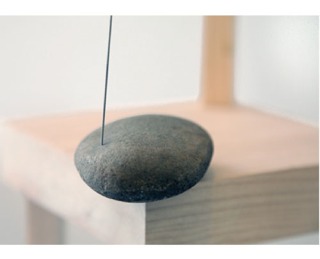
Gravity is Julianne Swartz’s third solo exhibition with Josee Bienvenu Gallery. In this new body of work, lightness and weight define and defy each other. Gravity-a body’s attraction towards the center of the earth- is the filament running through all the works. Some of the works push the limits of physical gravity very literally, and other works explore gravity metaphorically, as they refer to the limitations, fragility and endurance of the body, and the weight of human relationships. With gravity and lightness, Swartz places equal importance upon negative space, ambient sound, interruptions of sculptural line, and the interface between outside and inside. Her work encourages a quizzical reconsideration of our relationship to our body, to each other and to our surroundings.
Pier Paolo Calzolari at Marianne Boesky Gallery, 509 W 24 Street in collaboration with The Pace Gallery, 510 W 25 Street

On show at Marianne Boesky Gallery and The Pace Gallery, When the dreamer dies, what happens to the dream?, an historic exhibition of the work of Pier Paolo Calzolari. For this unique collaborative presentation, the two galleries’ spaces on 24th and 25th Street, respectively, will be temporarily conjoined to form one large space where Calzolari’s work can be presented in depth. A member of the Arte Povera group, his 1969 text “La casa ideale,” and its realization through a series of works, is considered one of the seminal statements of the movement. Rapidly evolving beyond the confines of a defined movement, over the subsequent decades Calzolari continued to experiment, exploring his ongoing interest in light, matter and time. This will be the artist’s first solo exhibition in New York since 1988 and will focus primarily on work created in the last 25 years.
Francesco Clemente at Mary Boone Gallery, 541 W 24 Street
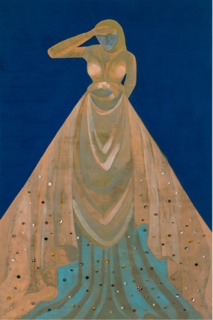
Nostalgia/Utopia is an exhibition of new works by Francesco Clemente. The foundation of Francesco Clemente’s work is the belief in the objectivity of imagination, radically different from the arbitrary and sentimental fantasy promoted by a materialistic society. Clemente believes in the hermetic tenet: “as above so below”. The strategy of his work is nomadic and syncretic, drawing on a variety of cultures, to indicate a commonality of experience. For the current exhibition, Clemente continues his masterful interlacing of disparate images, materials, and cultures that reflect many locations where he has lived and worked. The paintings run autonomously through Colonial Baroque, Afro-Brazilian, Indian, and urban American iconography. Deftly painted imagined scenes and figures co-exist with real sculptural objects affixed to the canvas surface. Also included in the exhibition is a new series of eighteen gouache and sanguine drawings. These intimate works function as a sourcebook of ideas expanded upon in the paintings.
Tauba Auerbach at Paula Cooper Gallery, 521 W 21 Street
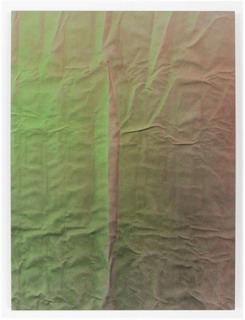
San Francisco-born, New York-based artist Tauba Auerbach has described her work as an attempt to reveal “new spectral and dimensional richness…both within and beyond the limits of perception.” Engaging a variety of media, ranging from painting and photography to book design and musical performance, Auerbach explores the limits of our structures and systems of logic (linguistic, mathematical, spatial) and the points at which they break down and open up onto new visual and poetic possibilities. In her acclaimed series of Fold paintings, first introduced in 2009, Auerbach presents powdery trompe l’oeil surfaces that register the traces of their former three-dimensionality. Alongside new Fold paintings, this exhibition will include a new series of Weave paintings, presented for the first time in the United States. As with folding, Auerbach uses weaving to reassess and thoroughly transform the flat picture plane. In addition to the paintings, the exhibition will present new photographs and sculptural objects, including Onyx, a deconstructed material volume printed and bound in book form.
Mark Innerst at DC Moore Gallery, 535 W 22 Street
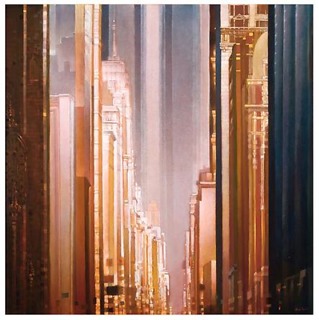
In his most recent work, Mark Innerst displays his mastery of painted forms, traversing the urban and natural world, the abstract and the real. Innerst’s fascination with the ways in which external reality is perceived “as something whole, rather than an accumulation of parts that all fit together” permeates this series. Through it, he explores an almost surreal interrelation between geometric forms and natural occurrences. The work is characterized by a clearly established formal structure and a unique luminism. A sense of innate light radiates from within each panel and in each painting, enhancing Innerst’s transfixing mix of content, form, paint and surface.
Richard Avedon at Gagosian Gallery, 522 W 21 Street
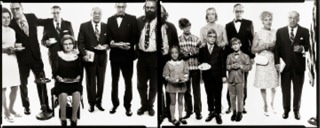
On display at the Gagosian Gallery is an exhibition of Richard Avedon’s legendary photographic murals and related portraits. In Avedon’s large-scale murals and the smaller, related portraits of the 1960s and 1970s, the artist sought to depict the spirit of the times. The transgendered Candy Darling and the naked Taylor Mead testify to the provocative countercultural behavior of the Factory; the positioning of characters within the mural suggest a complicated group dynamic. The spirit of political rebellion is embodied by the Chicago Seven mural, as well as the individual photos of Jean Genet, Bernardine Dohrn, and former turf gang-turned-human rights group, the Young Lords. The expanding definition of the American family is represented by the mural of the Ginsbergs, while earlier images of Allen with his partner Peter Orlovsky, were found to be too shocking for most publications in 1963. Powerful and dynamic, Avedon’s images became icons of their embattled times that resonate for the present and future.
Lucio Fontana at Gagosian Gallery, 555 W 24 Street

On display at Gagosian Gallery is a major survey of the work of Lucio Fontana. Six of his groundbreaking environments, known as Ambienti Spaziali, have been faithfully reconstructed, providing a completely new perspective for the rich and varied retrospective of more than one hundred major works that surrounds them. The exhibition includes many works that have rarely been seen and reunites important series from public and private collections. Inspired by, but surpassing, the language of Futurism, his work advocated doing away with the traditional supports of painting and sculpture. With the act of cutting a thinly painted monochromatic canvas with a sharp knife, Fontana exploded the definition—or at least the conventional space—of art. This act challenged the entire history of Western easel painting and led him to the understanding that painting was no longer about illusion contained within the dimensions of a canvas but, rather, a dynamic concept that blended form, color, architectural space, gesture, and light. From this moment on, Fontana entitled his works Concetti spaziali (Spatial Concepts), among which a progression of categories unfolds, predicated on the fertile dichotomy between the hole and cut. His assaults on the canvas were not merely physical; they were ways of making the viewer look beyond the fact of the painting into what he called “free space.”
Anish Kapoor at Gladstone Gallery, 515 W 24 Street, 530 W 21 Street
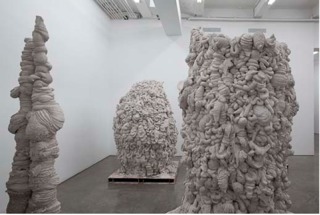
Gladstone Gallery is showing an exhibition of new work by Anish Kapoor, the artist’s first show in New York in four years. Spanning gallery spaces on W 24th Street and W 21st Street, this two-part exhibition demonstrates Kapoor’s ongoing exploration of the formal and conceptual framework that has informed his artistic practice for over three decades. In these new sculptural works, Kapoor brings together two major facets of his approach to the three-dimensional form, reflecting both the highly engineered and more organic processes within his oeuvre. At once austere and intimate, messy and refined, Kapoor’s work dually confronts and expands the basic nature of materiality and form. The 24th Street location features a multi-part installation comprised of twenty-two freestanding concrete sculptures. Formed by densely textured layers of poured concrete and mounted on metal palettes, these heaping sculptures evoke the sensorial nature of materiality and mass. Intentionally employing materials that could not hold their initial shape, Kapoor let the pieces unravel to create new organic forms that hover between contemporary object and ancient entity. These works linger in a state between coalescence and collapse, a relationship that speaks to Kapoor’s ongoing interest in the idea of “objectness” and the incomplete nature of the sculptural form.
Julia Fullerton-Batten at Jenkins Johnson Gallery, 521 W 26 Street
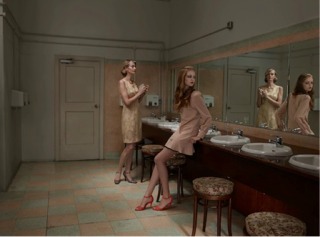
Jenkins Johnson Gallery is showing Persona, a solo exhibition by British photographer Julia Fullerton-Batten. The artist is known for her investigations of teenage girls, their psyches, and their relationships with others. Persona features the world-premiere of the new series Mothers & Daughters, Fullerton-Batten’s most recent exploration of the unique and difficult time of adolescence. The series, inspired by her and her sisters’ relationship with their mother, portrays the complex and sometimes challenging relationship between mothers and their daughters. She continues to work with street-cast, non-model subjects, whose subtle awkwardness and discomfort in front of the camera emphasize the reality of the scenes. Her use of eerie artificial light gives the final photographs a theatrical, other-worldly atmosphere. Through depictions of infant, adolescent, middle-aged, and elderly subjects in this series, Fullerton-Batten showcases the changing nature of mother-daughter relationships throughout their lifespan. Fullerton-Batten’s Awkward series further examines the complex relationships encountered during adolescence. This observation of the psychological intricacies and the dynamics of post-childhood development mirrors the motivation behind Mothers & Daughters, providing us with additional insight into the lives of teenagers.
Brice Marden at Matthew Marks Gallery, 526 W 22 Street
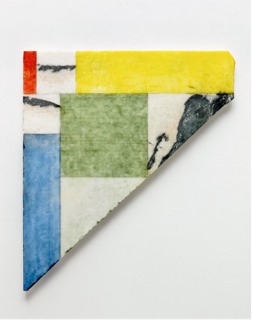
Reflecting the light and landscape of Greece, these paintings by Brice Marden feature vibrant colors and geometric compositions, which subtly incorporate each piece of marble’s natural variations. Marden’s earlier series of paintings on marble, completed over a six-year period between 1981 and 1987, played a principal role in the transition from his early monochromatic paintings to the later calligraphic work. Also on view will be a new large oil on linen painting, Polke Letter. An homage to Marden’s contemporary, Sigmar Polke, this painting is a continuation of the Letters series, first exhibited in 2010, the year of Polke’s death.
Thomas Demand at Matthew Marks Gallery, 522 W 22 Street
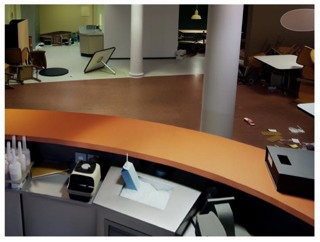
The centerpiece of Matthew Mark Gallery’s Thomas Demand exhibition will be a new film, Pacific Sun (2012). Based on a video of a cruise ship caught in a storm between the Republic of Vanuatu and Auckland, New Zealand which the artist found on Youtube, Pacific Sun follows the full narrative arc of the ship’s violent encounter in the Tasman Sea. Seen from the point of view of a security camera in the boat’s café, the film begins with the subtle movement of small items and escalates to a full emergency. Pacific Sun was filmed over fifteen months, and is the most ambitious undertaking of the artist’s career. The film was made on a full scale set and, like Demand’s models for his photographs, was completely constructed of paper and then destroyed. In addition to the film, Demand will exhibit a group of new photographs that include Control Room (2011), an image of the interior of the Fukushima Daichi power plant after last year’s Tsunami forced its workers to evacuate. This uncanny image shows ceiling panels hanging from rafters and a general state of disorder in a space that would be meticulously kept under normal circumstances. Demand has said of the photograph that it serves as way to recognize the bravery of the individuals who risked their personal safety in order to save others.
Gary Hume at Matthew Marks Gallery, 523 W 24 Street
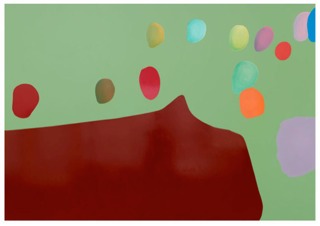
Gary Hume’s new body of work will be displayed in Anxiety and the Horse, a new exhibition which consists of a series of seven brightly colored abstract paintings made in Hume’s signature enamel on aluminum panels. Painted last year in his studio in upstate New York, Hume recently spoke about these works: ”I painted them as history paintings, the killing of Osama Bin Laden. That moment, that one second, in American history. One is of Obama. Another is of Angela Merkel; another one of George Bush, but they don’t look like them at all; another one is of a ‘Z’ that looks like a bit of a barn door. One day I’m in the studio looking at them thinking, you’re absolutely kidding me. This just looks like a bunch of balloons going across a field. When I was painting them I was thinking of Rembrandt and Franz Hals, and the paintings have got nothing in them of Rembrandt or Hals. I’d finished with the painting of the horse. I’m looking at the seven paintings thinking I like them but they’re all rubbish, because I’ve set out to make this vast history painting suite and it just looks like anxiety, and a horse. Anxiety and the horse. That’s exactly what they are. That’s all right. Then the paintings could live.”
NYC Museum Highlights for Summer 2012
Schiaparelli and Prada: Impossible Conversations at the Metropolitan Museum of Art, 1000 Fifth Avenue, www.metmuseum.org
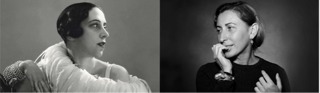
The Met’s Spring 2012 Costume Institute exhibition, Schiaparelli and Prada: Impossible Conversations, explores the striking affinities between Elsa Schiaparelli and Miuccia Prada, two Italian designers from different eras. Inspired by Miguel Covarrubias’s “Impossible Interviews” for Vanity Fair in the 1930s, the exhibition features orchestrated conversations between these iconic women to suggest new readings of their most innovative work. Iconic ensembles will be presented with videos of simulated conversations between Schiaparelli and Prada directed by Baz Luhrmann, focusing on how both women explore similar themes in their work through very different approaches.
Cindy Sherman at the Museum of Modern Art, 11 W 53 Street, www.moma.org
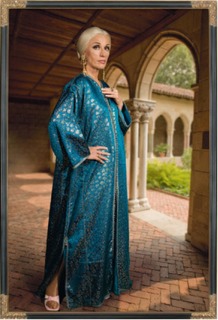
Bringing together more than 170 photographs, this retrospective survey of Cindy Sherman’s work traces the artist’s career from the mid 1970s to the present. Highlighted in the exhibition are in-depth presentations of her key series, including the groundbreaking series “Untitled Film Stills” (1977-80), the black-and-white pictures that feature the artist in stereotypical female roles inspired by 1950s and 1960s Hollywood, film noir, and European art-house films; her ornate history portraits (1989-90), in which the artist poses as aristocrats, clergymen, and milkmaids in the manner of old master paintings; and her larger-than-life society portraits (2008) that address the experience and representation of aging in the context of contemporary obsessions with youth and status. The exhibition will explore dominant themes throughout Sherman’s career, including artifice and fiction; cinema and performance; horror and the grotesque; myth, carnival, and fairy tale; and gender and class identity. Also included are Sherman’s recent photographic murals (2010), which will have their American premiere at MoMA.
…As Apple Pie at the Whitney Museum of American Art, 975 Madison Avenue, whitney.org
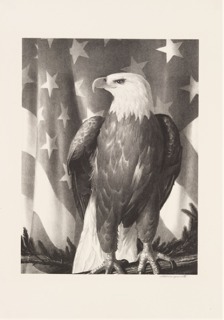
Images, like words, trigger a cultural and emotional knowledge of a shared national ethos. Artists have used this pictorial shorthand—sometimes straightforward, often obliquely—to comment on this country, its people, its political and social goals, its self-image. . . . as apple pie explores this phenomenon through a rotating installation drawn from the Museum’s holdings of works on paper by a diverse group of artists including William N. Copley, Edward Hopper, Jasper Johns, Elizabeth “Grandma” Layton, Willard Midgette, LeRoy Neiman, Joseph Pennell, Charles Ray, Jaune Quick-to-See Smith, and Stow Wengenroth.
Art of Another Kind: International Abstraction and the Guggenheim, 1949-1960 at the Solomon R. Guggenheim Museum, 1071 Fifth Avenue, www.guggenheim.org
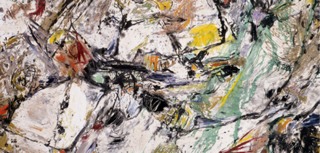
Pioneering artists in the post-World War II era alternatively embraced artistic freedom and gesture-based styles, nontraditional materials and counter-cultural references. Featuring nearly 100 works by Louise Bourgeois, Alberto Burri, Asger Jorn, Willem de Kooning, Jackson Pollock, Pierre Soulages, Antoni Tàpies, and Zao Wou-Ki, among others, this collection-based exhibition explores the affinities and differences between artists working continents apart in a period of great transition and rapid creative development.
Rineke Djikstra: A Retrospective at the Solomon R. Guggenheim Museum, 1071 Fifth Avenue, www.guggenheim.org
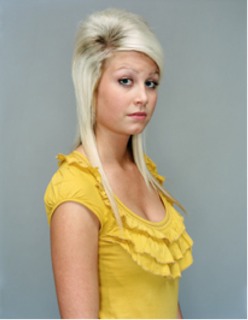
In works of classical simplicity and remarkable psychological depth, the Dutch artist Rineke Dijkstra presents a contemporary take on the genre of portraiture. Whether adolescents, soldiers, or new mothers, Dijkstra is fascinated by people in states of significant transition. Her sensitive pictures generate a monumental sense of presence, not only in how they record the details of an individual’s physical appearance, but also in how they illuminate subtly shifting inner states. Bringing together 70 large-scale color photographs and five video installations, this is the artist’s first major retrospective in the United States. Rineke Dijkstra is organized by the Solomon R. Guggenheim Museum and the San Francisco Museum of Modern Art.
Tacita Dean: Five Americans at the New Museum, 235 Bowery, www.newmuseum.org
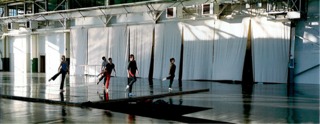
On display at the New Museum is an exhibition of works by British artist Tacita Dean—the most substantial presentation of the artist’s work in New York to date. The presentation focuses on a group of recent pieces that capture five important American artists and thinkers of the last fifty years and features Merce Cunningham, Leo Steinberg, Julie Mehretu, Claes Oldenburg, and Cy Twombly. These works are beautifully crafted portraits of each individual, opening a lens onto their artistic processes and personal memories. This installation, organized in close collaboration with Dean, provides insight into the way in which her filmmaking intersects with painting, sculpture, writing, and dance. This exhibition is part of a series of focus shows concentrating on a single project or body of work within an artist’s larger practice which began last May with presentations by Apichatpong Weerasethakul and Gustav Metzger.