
By Lucy Bamman and Lacy Davisson Doyle
Chelsea Exhibition Highlights
Beth Lipman: Precarious Possessions
Claire Oliver, 513 W. 26th Street, New York
January 17 – March 9, 2013
I find it harder and harder every day to live up to my blue china.
—Oscar Wilde
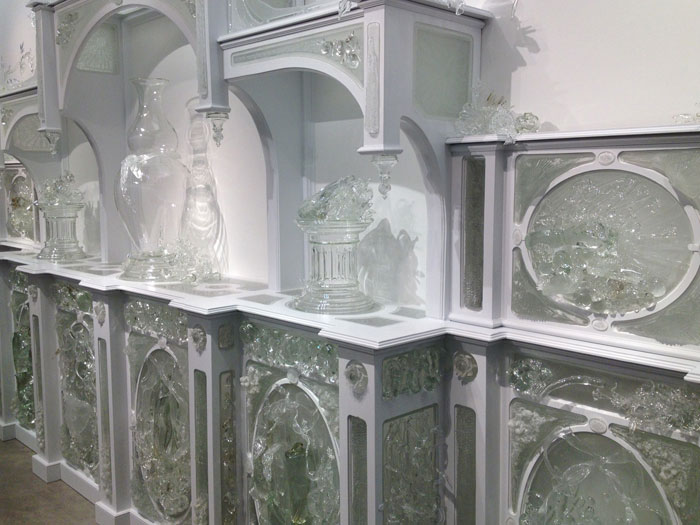 In the Victorian era, more was more; not a single surface was left unadorned, and every opportunity was taken to show off one’s wealth. An interior dressed in heavy fabrics and busy patterns, along with copious arrangements of objects within the home, signified affluence as well as high moral fiber. Turning this practice on its head, Beth Lipman’s work takes the language and object treatment from this time period and re-ignites the message for today’s beau monde. Using a historic lens to examine contemporary relationships between people and their belongings, the artist’s chosen medium of clear, mouth-blown glass addresses the issues of possession beyond reach and our inability to see our own indulgence. In Precarious Possessions, we see the continuation of the artist’s exploration of this concept on a grand scale. Lipman’s new works explore aspects of growth and decay, desire and consumption, and the literal embodiment of ourselves in our possessions.
Jane Hammond, Collaged Monoprints
Pace Prints, 521 W. 26th Street, New York
January 25 – March 2, 2013
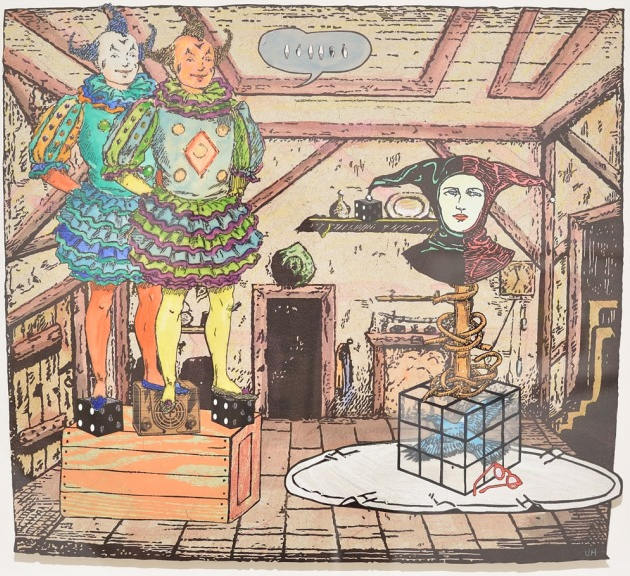 Pace Prints is currently showing an exhibition of new hand-colored monoprint drawings by Jane Hammond, created in the Pace Paper studios in Brooklyn, New York. A Room of One’s Own, the title given to each of the large-scale works in Hammond’s exhibition, describes the individuality of the depicted interior spaced based upon its invented composition, color and collaged elements. In this body of work, as always, Hammond works in a method of recombination, making an array of figures, animals and objects, combining and recombining them to create myriad and changing associations in each collage. All of this play occurs inside a recurring Renaissance-style room, with deep perspectival space. Each room is extensively hand-painted and contains up to seventy elements, individually cut out and collaged into the space. Hammond’s capacious hand-painting is combined with relief printing, linoleum block printing, etching, digital printing and rubber stamping in all of the works. Each of the widely-sourced elements exude multiple layers of meaning and associations, and the body of work as a whole provides insight into Hammond’s re-combinative semiotic process.
Song Dong: Song Dong Doing Nothing
Pace Gallery, 510 & 534 W. 25th Street, New York
January 18 – March 2, 2013
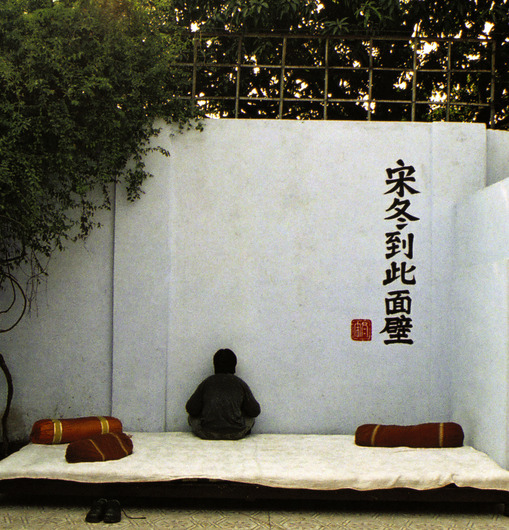 On view on block south at the Pace Gallery is a two-venue exhibition of the acclaimed Chinese conceptual artist Song Dong, known for his works that combine aspects of performance, video, photography, painting, installation, and sculpture. The gallery at 534 West 25th Street presents a survey Song’s works, spanning from 1994 to the present, including eighteen of Song’s performances, photographs, videos, and installations. The gallery at 510 West 25th Street centers on a new installation by the artist, expanding on his project for Documenta 13 and the Kiev Biennial. For over two decades, Song Dong has been at the forefront of Chinese contemporary art. Using modest, quotidian materials, Song confronts notions of impermanence, the reality of living in contemporary China, ideas of waste and consumption, the transformation of China’s urban environment, and the value of self-expression, even when it leaves no trace. Simultaneously poetic and political, personal and global, his work often explores larger social and cultural issues by drawing on deeply intimate, biographical experiences. The title of the exhibition, Song Dong Doing Nothing, references the Taoist concepts of “non-action” and “non-intention,” requiring a respect for natural order and a modest, humble way of leading life. Both ideas infuse Song’s work and inform his maxim: “That left undone goes undone in vain; that which is done is done still in vain; that done in vain must still be done.”
McDermott McGough, Suspicious of rooms without music or atmosphere
Cheim & Read, 547 W. 25th Street, New York
January 17 – February 23, 2013
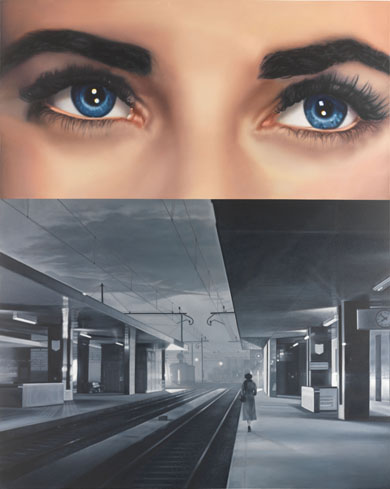 Also on view at Cheim & Read is new work by McDermott and McGough. David McDermott and Peter McGough were known in New York City’s East Village are scene during the 1980s for their self-immersion in the Victorian era, their lives and art strictly defined by the early 1900s. Through this time-based “portal,” McDermott and McGough challenged the chronological boundaries of art history and cultural identity. They questioned the nature of nostalgia and narrative, and the ways in which the past is conceptually and contextually reoriented for the future. The subsequent evolution of their work has found them more recently inspired by Hollywood cinema, advertising tropes, and comic books of the 1950s and 60s – the duo again searching for identity within an artificial world. In their current exhibition, focus resides in images of self-introspection and human emotion: scenes which emphasize the absurdity and cruelty of life’s journey are at the forefront. Several photo-realist paintings juxtapose carefully selected movie scenes in which a decisive moment is central. Accompanying works on paper evolved from the paintings, and contrast the latter’s careful realism with a looser hand. These images also begin with a crucial cinematic moment, but are elaborated upon with faceted, brightly colored, almost psychedelic shapes.
Don Bachardy, Portraits From a Canyon: Los Angeles in the 60s and 70s, selected by Jack Pierson
Cheim & Read, 547 W. 25th Street, New York
January 17 – February 23, 2013
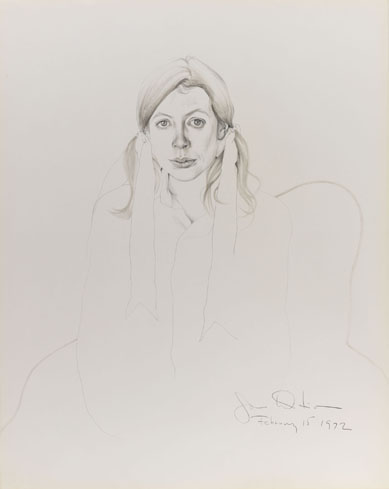 Born in Los Angeles in 1934, Don Bachardy attended UCLA and the Chouinard Art Institute, Los Angeles and the Slade School of Art, London. Through his relationship with novelist Christopher Isherwood, Bachardy was introduced to a talented circle of Bohemian artists and writers, who the artist embraced as his lively subjects. By capturing the essence of his subjects, Bachardy conveys the spirit of the time and place in which they were made. The hair, clothes and postures depicted are certainly emblematic of 1960s and 70s L.A., but it is Bachardy’s unique ability to render his sitter’s distinctive presence that is most evocative of the period. The portraits selected for this show are a remarkable collection– among them Warren Beatty and Richard Deacon, Natalie Wood, Jane Fonda, and Katherine Hepburn, Joan Crawford and a youthful Elton John, artist Ed Ruscha and writers Joan Didion, Anaïs Nin, and James Baldwin.
Tam Van Tran, Leaves of Ore
Ameringer | McEnery | Yohe, 525 W. 22nd Street, New York
February 14 – March 16, 2013
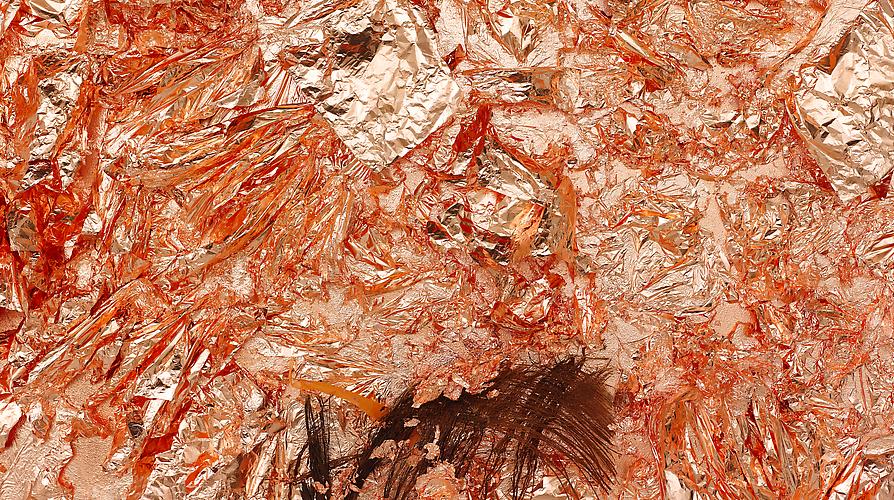 On view at Ameringer | McEnery | Yohe is its first solo exhibition of work by Vietnamese-American artist Tam Van Tran. Tam Van Tran has been strongly influenced by landscapes: the landscapes of his Vietnamese childhood, where he lived near the ocean and Da Nang military airbase, and the landscapes of his current home of Los Angeles and the California coast. His works start with fragments such as porcelain shards that evoke memories of ceramic jars used by his mother, or leaves of copper sheets that lift with air currents like palm fronds in the Santa Ana winds. The fragments are collaged onto canvas surfaces and natural materials, clay, paint and paper, which are laid on ceramic tiles and embedded beneath recycled glass. The materials embody Tran’s recalled experiences of bombs floating onto shore, villagers fishing with grenades, and intermittent evacuations. Tran is acutely aware of himself as a Vietnamese-American absorbing both Eastern and Western cultural influences. His work incorporates and transforms references from Nouveau Réalisme, Arte Povera, and California ceramic tradition, and may be as easily compared to John Chamberlain’s crushed metal sculptures as it may Asian gold-leafed folding screens. In the tradition of artists such as Kurt Schwitters and Robert Rauschenberg, Tran actively considers, explores, and expands painting concepts.
Midtown Gallery Highlights
Bernard Frize, Winter Diary
Pace Gallery, 32 E. 57th Street, New York
February 1 – March 10, 2013
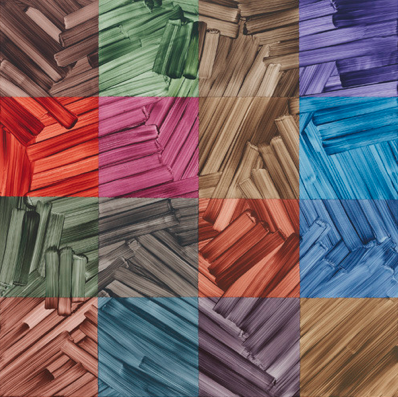 Uptown at Pace Gallery’s space on East 57th Street is an exhibition of new work by French painter Bernard Frize. Though Frize’s work has been widely exhibited throughout Europe, this is the artist’s first New York presentation in over a decade. The exhibition features fifteen new paintings that continue Frize’s process-oriented practice of creating work according to systems, rules, and chance. For the paintings in Winter Diary, each large canvas is primed with a thick layer of resin, which creates a smooth plastic surface onto which acrylic paint is applied. Over the past four decades, Frize has intentionally reduced his practice to the application of color to a canvas, developing a seemingly endless array of methods for making chromatically brilliant, abstract paintings. For each series, Frize devises an idea or rule that will generate a painting, allowing the final work to emerge through the implementation of a process. Once the plan is established, he executes it, sometimes in concert with assistants and often using specially-made tools, such as a paintbrush made out of many different-sized brushes tied together. In other works, Frize uses rollers to apply paint in carefully measured areas or works with absurdly large or small brushes.
L.C. Armstrong, L.C. Armstrong/Central Park Paintings
Marlborough Gallery, 40 W. 57th Street, New York
February 13 – March 16, 2013
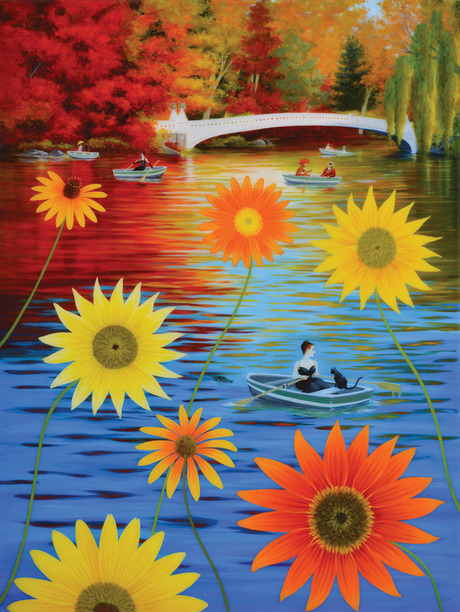 Down the street at the Marlborough Gallery is an exhibition of new work by Brooklyn artist L.C. Armstrong. Comprised of ap- proximately 12 paintings executed in Armstrong’s signature technique of vibrant acrylic paint layered with a thick coat of resin on linen on panel, the exhibition features fantastical land- scapes that explore the surprises and whimsies of New York’s Central Park. From the 12 foot-long triptych to the intimate 20 x 16 inch single panels, Armstrong’s compositions teem with humans, animals, and exotic flowers coexisting in a dreamlike utopia. She remarked that, “Central Park is surreal; every visitor brings their own unique view on life.” In Bow Bridge Boaters, the viewer peers through a screen of sunflowers and daisies to glimpse the tiny boaters on the pond, with a lush proliferation of fiery fall foliage in the background. In a whimsical twist, Armstrong has populated the boats with figures from art history and popular culture rather than with tourists. Holly Golightly, John Singer Sargeant’s Madame X, a couple from Manet’s 1874 painting Boating, and Sir Joshua Reynold’s 1782 portrait of Captain George Coussmaker paired unexpectedly with a Native American, all float along in perfect harmony.
Julio Larraz, Julio Larraz
Marlborough Gallery, 40 W. 57th Street, New York
February 13 – March 16, 2013
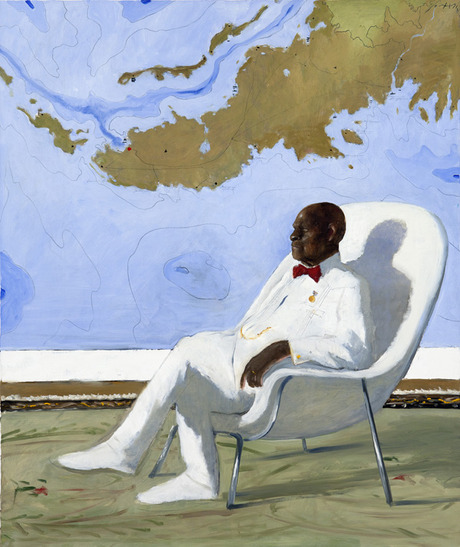 Also on view at the Marlborough Gallery is an exhibition of recent work by the Cuban born, American painter, Julio Larraz. The exhibition will feature approximately 24 large paintings on canvas and 4 watercolors and pastels on paper. Stylistically, Larraz’s work may be characterized by simplicity of touch, dramatic lighting, sensuous colors, exaggerated scale, and a combination of reality and fantasy that is generally tropical in atmosphere. His subjects are often metaphors for such things as isolation, melancholy, the absurdity of power, or political intrigue. Many of the pieces included in this exhibition embody an overarching characteristic of Larraz’s work: he creates a strong nar- rative element with latent implications that go beyond what is represented on the canvas. The critic Christofer Finch wrote, “a constant in Larraz’s art is the always ambiguous interaction between man and nature… Larraz has a virtuoso’s ability to conjure up the physical world. Beyond this he takes a poet’s delight in evoking imaginary universes, so that every image seems to take on a special significance in the context of the whole, as if it has been plucked from some epic that has yet to be written.”