
Having now made my usual multiple visits back to the Whitney Biennial I’m scoping out below what I thought to be the strongest, most intriguing or simply most promising looking works in the show. For those of you with some time over the holidays I recommend a visit with family or out of town visitors. Perhaps with the exception of Stephanie Sinclair’s extremely disturbing self-immolation photographs, the exhibition is generally child friendly although I have not yet watched every film and video piece in its entirety.
The catalogue, if lighter this year on what are usually stimulating guest written essays, is serviceable enough and provides a thorough historical summing up for those relatively new to the lineage of the Biennials. With that in mind I recommend a warm up on the Fifth Floor for a walk through Collecting Biennials, a selection of acquisitions made by the Museum from past shows. You will see both old friends and make several new acquaintances. Descend by the stairs and take an anticlockwise route on the remaining floors.
Fourth Floor
R. H. Quaytman
Exploring questions of contextuality, R.H. Quaytman builds her Whitney installation around one of the distinctive Marcel Breuer building’s steeply angled windows. Nine separate painting elements in this corner gallery cohere into an examination of perception in and of the Museum space. The overlaying complexities of memory and historical association are fore grounded through a wry play on the Whitney’s own mid-century Hopper masterpiece Woman in the Sun of 1961.
Lesley Vance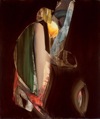
Palette knife forceful yet strangely elusive abstracts from Lesley Vance call to mind the seventeenth century Spaniards Zubarán and Cotán but nevertheless strike a wholeheartedly contemporary posture. Shape shifting beyond any genre definition, these are neither still lives nor portraits, not landscapes but then not entirely abstract either. A somber but luminous palette and their intimate scale make up close examination a very sensual experience.
Curtis Mann
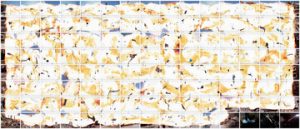 Curtis Mann’s enormous synthetic polymer varnished and bleached chromogenic print mural in the next gallery works on an entirely different scale from the Vance studies but also demands close scrutiny. A mosaic of found and treated images that have been partially defaced, After the Dust, Second View (Beirut), 2009 requires some visual time and mental effort in reassembling the fragmented landscape if any meaning is to be made of it.
Tauba Auerbach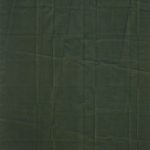
The struggle to reconcile the data relayed by the eye to the content received and processed by the brain is further taxed by Tauba Auerbach’s trompe l’oeil Crumple works. Much more than well-rendered gimmicks of the op art variety, Auerbach tweaks our notions not only of depth, dimension and scale but also of the very trustworthiness of color itself.
The Bruce High Quality Foundation
On every visit this piece had a crowd around it and with good cause. A mesmerizing video and film montage with haunting voice over by this much talked about anonymous collaborative who are all named Bruce. Don’t ask, just go and see it.
Third Floor
Thomas Houseago
A piece that seems to have been a favorite for illustrating press reviews of the Biennial so far, this lumpy, oafish chimera of a thing has an endearing vulnerability to it even before you read that it is titled Baby. A far cry from the heroic forms and noble materials of traditional or even mid century Minimalist sculpture, Baby gamely reveals his D.I.Y heart and pre-fab soul.
Alex Hubbard
Of the many (too many?) film and video pieces in this show – I counted seven clustered in the corner of the Third Floor alone – the Alex Hubbard piece was, despite its zany narrative and absurdist premise, one of the most coherent, not to mention amusing, pieces in the exhibition.
Kerry Tribe
Far from funny but rather deeply thought provoking is Kelly Tribe’s poignant documentary style piece investigating memory, its loss and the implications for core human identity. The subject of the film is sensitively portrayed by a professional actor, so keeping the work out of the realm of voyeurism or exploitation.
Second Floor
Dawn Clements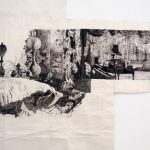
Not to my surprise, I was particularly drawn to a sprawling pen and ink interior by Dawn Clements, an artist we have seen out in Brooklyn at Pierogi and whose work was available at the Armory Show earlier this month. Clements’ tagged on and patched together supports meander compellingly through narratives that read like a novel or screen like a movie rather than remaining static as a painting.
The Entire Corner Gallery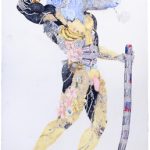
So I lied about this being a Top Ten only but there was nothing in this whole room that I could take off my list. Robert Williams’ Astrophysically Modified Real Estate watercolors, George Condo’s monster in a landscape oil, Verne Dawson’s James Ensoresque pastiche, Huma Bhabba’s improvisational but nevertheless heroic assemblage and Aurel Schmidt’s Arcimboldo-like synthesis of both the abject and the gorgeous made this gallery its own mini-retrospective of the best that’s going on in contemporary surrealism.